
Organic clicks are down 58% because AI Overviews capture traffic before users leave Google. Yet, AI-referred visitors convert 42% better than traditional traffic. The bottleneck is no longer content volume; it is architecture. Moving to a Machine-First Architecture prepares your SaaS estate for autonomous AI agents controlling trillion-dollar procurement budgets. This blueprint moves your brand past the visual storefront into verifiable protocol endpoints.
Engineering for Non-Human Consumers — How to create a technical web foundation built for the distinct constraints of non-human consumers.
The Four Pillars of Machine-First Architecture — The precise architectural changes required across the four pillars of Identity, Structure, Content, and Interaction.
Transitioning to Active Commerce Protocols — How to transition your engineering stack to active commerce protocols like ACP, UCP, and WebMCP to capture programmatic buyers.
The C-Suite KPI Framework — Which new reporting metrics and KPIs to present to your CEO and CFO to justify machine-readability investments and protect top-line revenue.
I. The Death of the Click-Based Storefront
For three decades, the contract governing commercial web development remained completely unchanged. Businesses built digital estates exclusively for human visitors. Marketing teams spent substantial portions of their budgets iterating on visual layouts, optimizing user experience (UX) flows, crafting persuasive messaging, and running click-based attribution pipelines.
The human-first layout model has become an immediate financial liability.
Clickstream data from 846,000 search sessions show that 69% of Google queries now resolve into “zero-click” interactions. When a Google AI Overview or a generative platform like Perplexity answers a user’s prompt, the organic click-through rate (CTR) for top-ranking organic positions drops by 58%. The traditional inbound pipeline—where human prospects navigate to a homepage, read a self-promotional value proposition, and manually fill out form fields—is bleeding out.
The internet is undergoing a rapid transformation from a web of visual pages to a web of active, machine-readable services. Today, the primary visitor to your digital estate is an autonomous AI agent. Runtimes such as ChatGPT Atlas, Google’s Project Mariner, and Perplexity Comet are actively researching vendor features, sifting through documentation, and executing enterprise signups on behalf of corporate buyers.
To protect your pipeline, your B2B SaaS organization must execute a definitive strategic pivot: implementing a Machine-First Architecture. This methodology demands that we build websites designed around what machines need to consume, understand, and act on, then layer the human experience gracefully on top.
II. The Evolutionary Principle: Restraints as a Moat
To navigate this paradigm, Slobodan Manić established the conceptual parallel to the mobile-first design revolution in the machine-first article we referenced above. As Manić details, mobile-first design forced developers to recognize that the small screen was the primary context for users, requiring them to design for that physical restraint first. Machine-First Architecture applies that identical constraint logic to the reality of 2026. It recognizes that non-human entities are becoming the primary gatekeepers of enterprise commerce, and it architectures for that constraint first.
Importantly, designing a machine-first estate does not mean human-last. Building for the web’s most restricted consumer: a machine that cannot interpret visual styling, guess at ambiguous copy, or recover from technical gaps, creates a flawless structural foundation. This extreme technical discipline creates a robust environment that serves human visitors and software agents equally well.
The revenue stakes for mid-market and enterprise B2B SaaS are immediate. Adobe’s Q1 2026 data shows that AI-referred traffic converts 42% better than traditional search traffic. However, while human self-serve signup abandonment averages 70%, autonomous agents log a near-100% abandonment rate on visually heavy, JavaScript-dependent sites that lack machine-readable protocol layers.
III. When to Layer the Human Interface
A machine-first philosophy does not require you to abandon your brand’s creative identity or human-centric design aesthetics. Instead, it reorganizes where creative execution lives in the development stack. Visual assets, brand design, and copy function strictly as an enhancement layer on top of a data-first framework.
The required workflow changes the order of development:
- Define the underlying data models and technical entities.
- Write the content and insert internal/external linking vectors.
- Embed schema markup and server-rendered HTML blocks simultaneously.
- Layer the visual brand identity, CSS styling, and visual asset mapping on top.
When human buyers continue past the initial summary fold, they encounter a polished, high-end visual experience. But when an AI crawler hits that same endpoint, it bypasses the aesthetic canvas entirely, effortlessly extracting data points from a clean, server-side rendered HTML structure.
IV. The Four Pillars of Machine-First Architecture
To transition your B2B SaaS digital estate from a passive storefront to an active endpoint, your development and product teams must build around the four pillars:
1. Identity Resolution
AI systems cannot evaluate, recommend, or transact with a brand they cannot confidently resolve. Large language models build internal representations of businesses by synthesizing signals from dozens of external platforms. If your website states you are an “Enterprise CRM,” your LinkedIn page reads “Digital Agency,” and your industry directory listings state “IT Consultants,” the system drops its entity confidence and defaults to a competitor.
Organizations must publish a single, structured canonical definition—a single source of truth hosted on your domain that lists your core attributes, leadership, and services in data fields rather than descriptive paragraphs.
2. Structural Liquidity
Machine information hierarchy is structural, not visual. While humans interpret hierarchy through font size and visual weight, AI systems prioritize content based on heading levels (H2/H3 tags), microdata annotations, and text strings within the first 200 words of a section.
Furthermore, you must eliminate technical debt related to client-side single-page applications (SPAs). If your features, pricing tables, or signup parameters require client-side JavaScript execution to render, AI crawlers will index a completely blank shell. All critical data must exist in the initial HTML response. We’ve resolved this exact failure mode before: a global RPO enterprise’s “JavaScript Blackout” was restored via a 30-day technical sprint that unlocked 100% ad-spend efficiency.
3. Content Modularity
To earn placement in generative engine results, you must abandon marketing fluff and embrace citable specificity. Content must be constructed as collections of modular knowledge units that can function independently when extracted by an AI system.
Lead every page with Answer-First Architecture. The first paragraph must state a self-contained, citable answer to the primary user’s intent, as research shows that 44.2% of all AI search citations originate from the first 30% of the content. Additionally, integrate proprietary statistics and direct subject-matter expertise, which improve AI visibility by up to 41%.
4. Interactive Pathways
The final pillar covers non-human entities that autonomously execute tasks on your website, with no human in the loop. Notably, checkout and signups are transitioning from layout problems to protocol problems.
To enable agentic transaction, you must move beyond text extraction to structured protocol readiness. This means hosting a capability manifest at a dedicated, well-known endpoint (/.well-known/ucp), allowing agents to understand your platform’s supported operations programmatically rather than through brittle document object model (DOM) scraping.
V. The Protocol Ecosystem: Implementing the Stack
The technical protocols that power autonomous execution have crystallized around the open standards of the Agentic AI Foundation, hosted by the Linux Foundation. Your technical roadmap must integrate these three layers to make your software services fully transactable to machines:
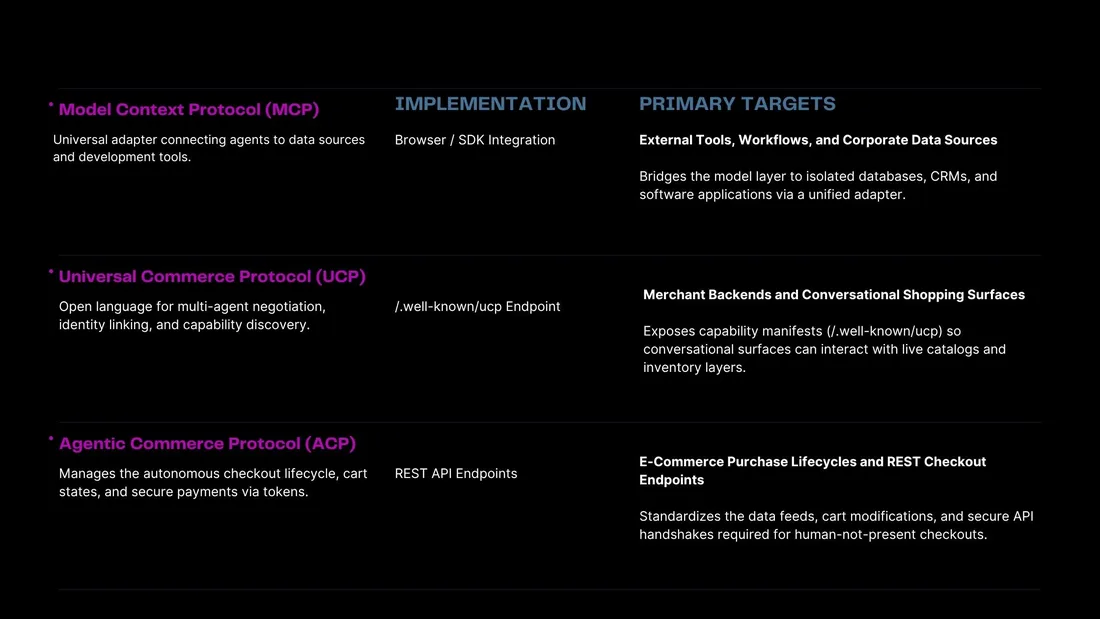
By deploying this stack, you replace human-centric visual sequences with precise API handshakes, using secure frameworks such as the Agent Payments Protocol (AP2) to verify cryptographic proof of user intent without exposing raw credentials to the agent.
VI. The C-Suite Reporting Framework: Transitioning Your Metrics
Retooling your estate for a machine-first era introduces a critical internal friction point: explaining this shift to the CEO and CFO. Most sophisticated B2B SaaS marketing leaders already understand that pouring budget into legacy SEO or high-volume content production is an operational waste. The true challenge is reporting performance upward and protecting the organization’s revenue inside an attribution vacuum.
When traditional metrics like pageviews, sessions, and visual form conversions drop due to zero-click layouts, traditional dashboards signal an artificial crisis. To protect your budget and align with executive leadership, you must transition your reporting from human-centric engagement metrics to programmatic infrastructure KPIs:
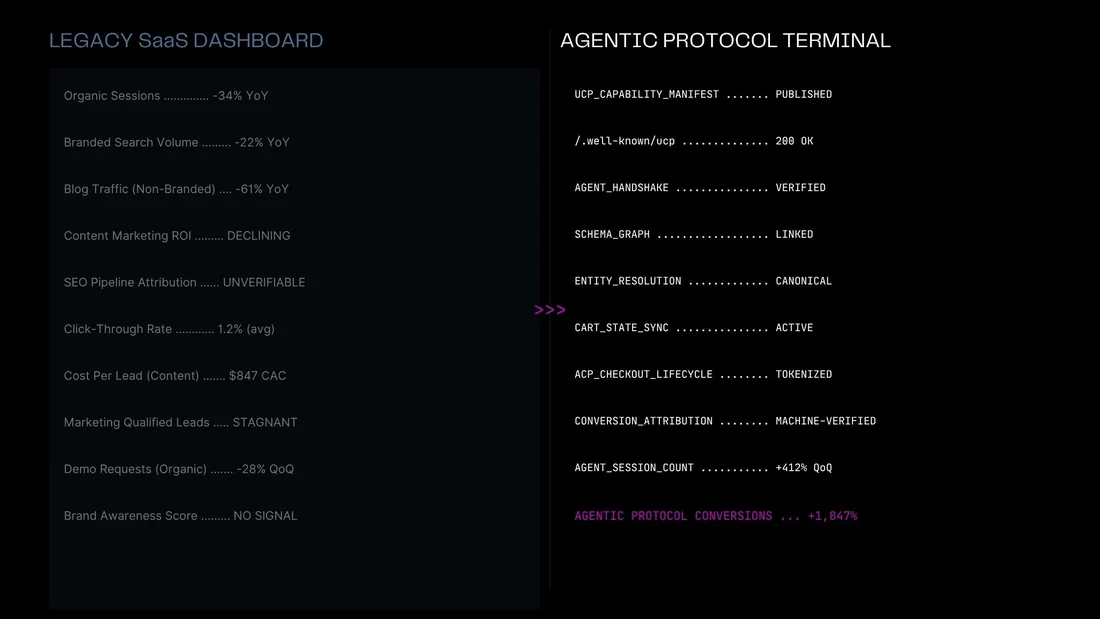
The Three Core KPIs to Present to Your Board:
- Citation Share (Share of Voice in LLMs): Stop reporting on search engine rankings. Instead, utilize specialized tracking platforms to measure your brand’s citation volume and baseline share of voice across ChatGPT, Claude, Gemini, and Perplexity. This quantifies exactly how often your brand is selected as the primary source of truth for your category.
- Extractive Efficiency & Agent Readiness: Leverage public scanning infrastructure, such as Cloudflare’s public agent scanner at isitagentready.com, to provide a verifiable, numeric readiness score out of 100. Presenting an objective “Agent Readiness Score” to the CEO and CFO shifts the conversation from abstract marketing theories to concrete technical risk management.
- Agentic Protocol Conversions (API Pipe Value): Isolate traffic from the Google-Agent fetcher or from user proxies that append utm_source=chatgpt.com. Track and report on successful signups, actions, and transactions completed directly through your WebMCP, UCP, and ACP protocol endpoints.
By framing your digital estate as high-value infrastructure rather than a superficial marketing cost, you give the C-suite the exact vocabulary they need to understand the modern buyer’s journey. You show them that by eliminating visual friction points for autonomous agents, you are directly capturing the highest-converting, highest-velocity revenue layer in your sector.
Let’s Secure Your Strategic Clarity
Is your B2B SaaS platform structured as a functional machine endpoint, or is your revenue trapped behind a visual wall? Penpixel Creative specializes in aligning technical, verbal, and visual signals to liquidate your entity debt and ensure your brand is fully transactable to autonomous systems.
↳ Request an AI-Search Readiness Audit from Penpixel Creative Today.
Frequently Asked Questions
What are the four core architectural pillars required for a machine-first digital estate? The four pillars are Identity Resolution (publishing a structured canonical definition of corporate entities), Structural Liquidity (eliminating client-side SPA dependencies to surface all data in the initial HTML response), Content Modularity (building citable, independent knowledge blocks), and Interactive Pathways (implementing programmatic capability manifests instead of relying on DOM scraping).
Why does a client-side JavaScript Single-Page Application (SPA) hurt AI agent conversions? Autonomous AI agents prioritize speed and computational efficiency. If critical feature definitions, product pricing tables, or signup parameters require client-side execution to render, machine crawlers will index a blank shell, leading directly to immediate session abandonment.
How do WebMCP, UCP, and ACP protocols replace traditional visual workflows? These protocols replace visual user sequences with direct API handshakes. The Model Context Protocol (MCP) securely connects machine agents to data repositories, the Universal Commerce Protocol (UCP) exposes machine-readable capability manifests via dedicated domain endpoints, and the Agentic Commerce Protocol (ACP) standardizes autonomous, human-not-present checkouts.
What is Answer-First Architecture, and why does its location on the page matter? Answer-First Architecture is the practice of delivering a self-contained, highly specific, and citable conclusion in the primary paragraph of an endpoint. This is operationally critical because data indicates that roughly 44.2% of all generative search engine citations originate from the first 30% of a page’s content.
How do we isolate and track autonomous agent conversions on the backend? To track Agentic Protocol Conversions, configure server-side analytics pipelines to isolate traffic matching specific non-human user-agent tokens (such as the Google-Agent fetcher) or incoming user proxies that explicitly pass conversational attribution parameters like utm_source=chatgpt.com.