
The Cost of Entity Debt: Why AI Systems Are Hallucinating Your Brand

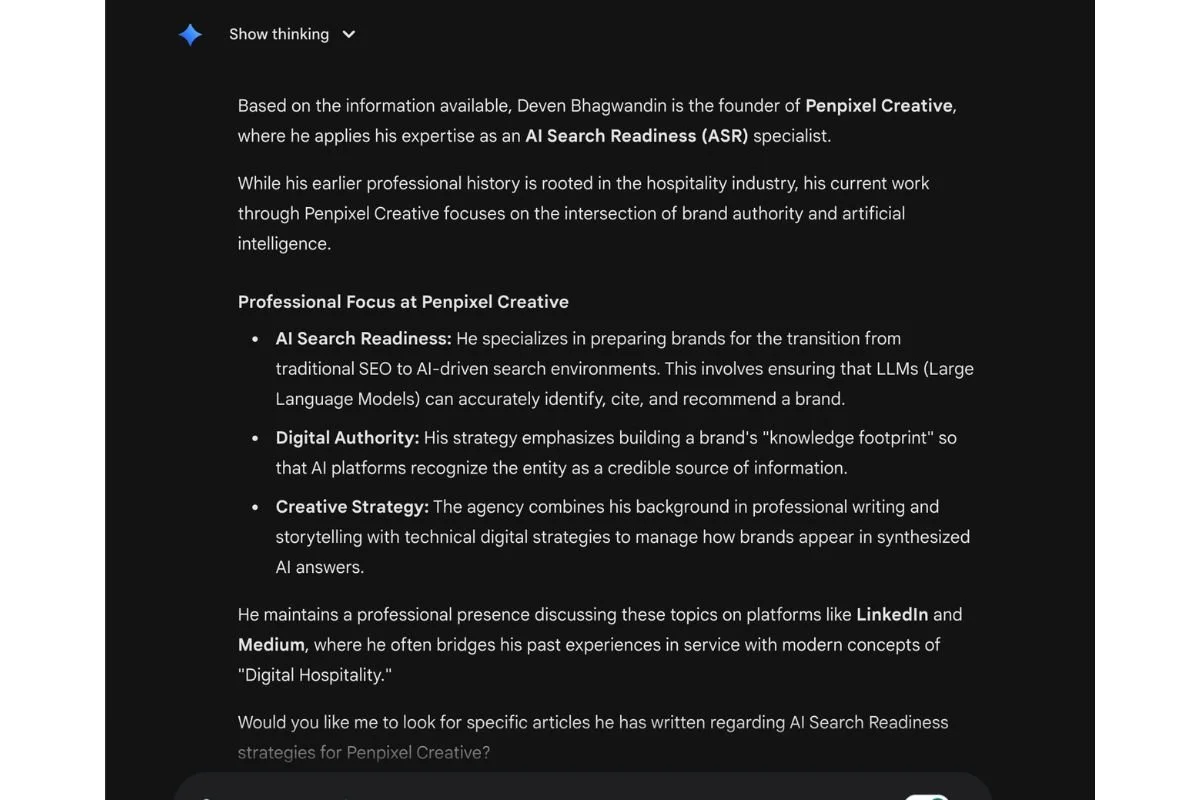
I looked myself up in Gemini recently. The result was disappointing.
The system generated a totally incorrect answer, based on a career I left years ago. Even when prompted to correct itself, the LLM doubled down, eventually hallucinating that I was the “founder of the ASR Group”—a company that does not exist.
If an AI system can’t get a founder’s history right, imagine what it’s doing to your brand’s legacy data.
The Reality of Entity Debt in the AI Era
Most marketing leaders are familiar with technical debt: the cost of rework caused by choosing an easy solution now instead of a better approach that takes longer.
Now, we are facing a new, more dangerous liability in AI search: Entity Debt.
Entity Debt occurs when legacy SEO signals, outdated PR mentions, and fragmented brand data are so structurally dominant that they drown out your current authority. AI models (LLMs) are trained on massive datasets of "legacy" internet data. If your brand has evolved, but your digital footprint is anchored in 2019, the AI will prioritize the older, more "vetted" data over your current reality.
Why LLMs Struggle with Brand Evolution
Signal Weight: AI systems look for consensus across the web. If 1,000 pages say you are "Company A" and only 50 pages (your new site) say you are "Company B," the machine defaults to the majority.
Lack of Explicit Structure: Without clear technical signposting (like Schema markup), AI is forced to "guess" which information is the most current.
Training Cutoffs: While models are getting better at real-time search, their core understanding of "who you are" is often baked into their initial training weights.
The Visibility Vacuum: When Accuracy Becomes Optional
When an AI system encounters Entity Debt, it creates a Visibility Vacuum. An LLM’s primary goal is to provide a confident answer. If it cannot find a clear, consistent, and reinforced signal of who your brand is today, it does not return a "404 Not Found" error.
Instead, it fills that vacuum with the most "probable" information it can find.
The Three Consequences of a Visibility Vacuum
Hallucination: The system blends your old data with unrelated facts to create a "confident lie." In my case, Gemini took my background in AI-Search Readiness and fabricated a professional entity (the "ASR Group") to make the answer sound more authoritative. To a buyer, this appears as a lack of credibility.
Competitor Substitution: If a competitor has a cleaner "AI signal" for your category, the LLM will cite them as the authority, even if your brand has more legacy prestige.
The Silent Exit: Buyers are increasingly using AI for the "evaluation" phase of the funnel. If the AI provides an outdated or incorrect summary of your services, the buyer leaves your funnel before reaching your website.
Consequences of not preparing for AI search.
How to Identify Your Brand’s Debt
To understand if your brand is at risk, you must evaluate your presence across the AI-Search Ecosystem:
The Core Entity: Does the Knowledge Graph see you as one unified business or a collection of fragmented projects?
Citation Readiness: Is your most valuable proprietary data structured in a way that an LLM can easily ingest and credit?
Signal Consistency: Do your LinkedIn profiles, PR mentions, and technical metadata all point to the same "Core Thesis"?
Closing the Gap: From Legacy Debt to AI Clarity
The risk to your brand isn’t just "being wrong" in a chat interface; it’s becoming invisible to the next generation of buyers who rely on generated answers to make decisions.
You cannot fix Entity Debt by simply publishing more content. In fact, adding more unstructured content to a fragmented system often worsens the problem by introducing "noise" into the machine’s interpretation.
The Path to AI-Search Readiness
Audit the Baseline: You must know exactly how AI systems currently categorize your brand.
Prune the Noise: Actively work to diminish the weight of outdated legacy signals.
Reinforce the Thesis: Use a consistent logic and technical structure across every digital surface to "force" the AI to recognize your current authority.
Marketing is reorganizing around visibility, not just rankings. The brands that win the next decade won't be the ones with the most content, but the ones with the most clarity.
Secure Your Brand’s Future with an AI-Search Readiness Audit
The window to build this capability early is still open, but the "Visibility Vacuum" hardens quickly. Once an AI system builds a conceptual map of your brand based on incorrect data, it requires significantly more energy to retrain that perception.
An AI-Search Readiness Audit provides the clarity you need to stop the "hallucinations" and start the transition into a cited authority.
Don't let the machines guess who you are. [Contact Penpixel Creative today for an AI-Search Readiness Audit]