
Beyond Keywords: How to Fix Your Brand’s Entity Recognition in AI

Most businesses are still obsessed with the wrong metric. While they fight a positioning war on Google (measuring success in rank positions and organic traffic), the landscape has shifted beneath them.
Yes, ranking on page one still matters today, but its relevance is decaying. While SEO teams are busy optimizing title tags, the battlefield has moved. AI tools like ChatGPT, Perplexity, Claude, and Gemini don't process web pages the way traditional crawlers do. They don't just match query strings to keyword strings.
They understand entities.
If your brand’s "hidden layer" (the entity layer) is broken or undefined, you are invisible to AI. Your backlinks, H1s, and keyword density won't save you.
If the machines don’t know what your business is, they cannot recommend it.
What is the "Entity Layer"?
LLMs have fundamentally shifted how answers are provided, which is why traditional SEO strategies are failing in the AI search era. To an AI, your business is not just a website; it is an entity.
Defining the Entity
In computer science and AI, an entity is a distinct, well-defined object; a person, place, thing, or concept that is uniquely identifiable.
Entities are defined by:
Attributes: Specific data points (e.g., your founding date, location, or CEO).
Relationships: How you connect to other objects (e.g., your partnership with a software provider or your industry category).
These entities live within a Knowledge Graph. While Google has its own Knowledge Graph, LLMs use their training data to build internal maps of how these entities relate to one another.
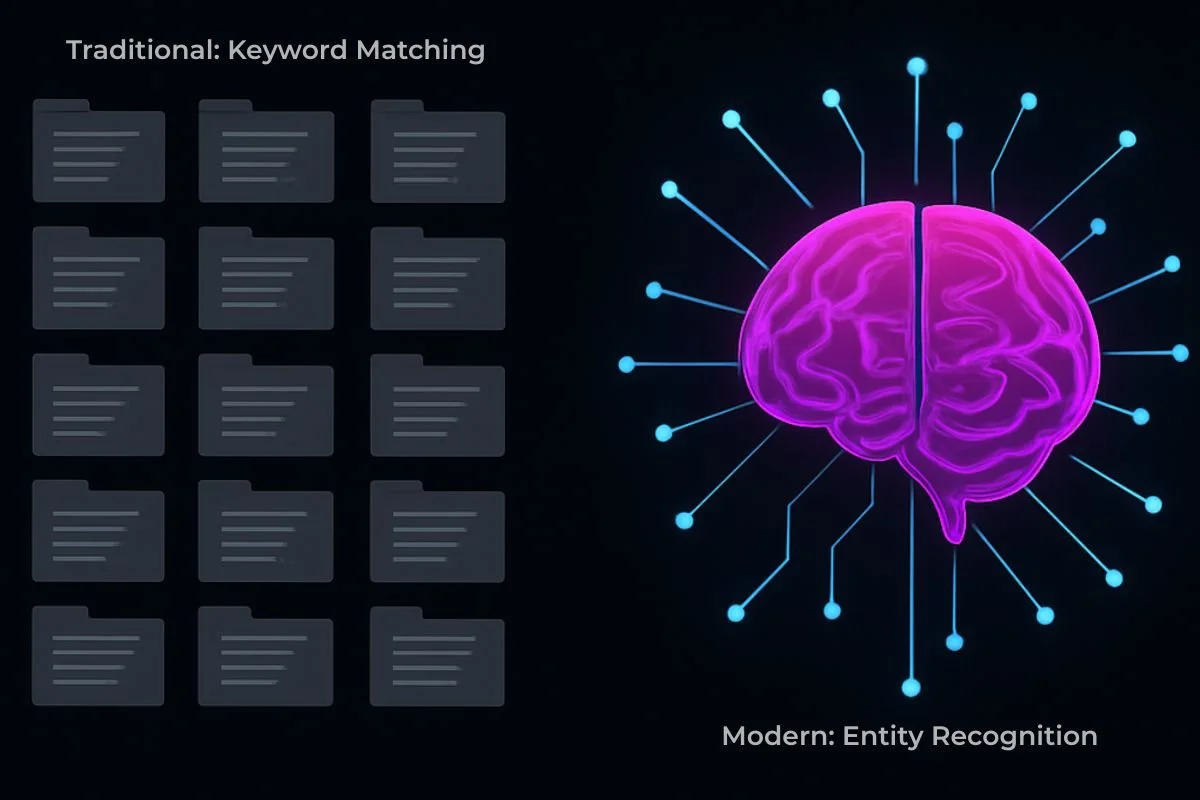
The Analogy: > Traditional SEO is a library index card system. It looks for matching words. If the card says "Marketing Agency," it files you under "Marketing Agency."
AI Search is like a tailored recommendation from a trusted consultant. The model weighs everything it knows about your specialty, reputation, and historical accuracy before it even mentions your name.
If your entity is not clearly defined, you don't just "rank lower, "you cease to exist in the generated answer.
The "Hallucination" Risk: When AI Gets You Wrong
In business, invisibility is a problem.
Misclassification is a catastrophe.
Because Large Language Models (LLMs) are predictive engines, they are designed to provide an answer even when data is missing.
So, when your entity is undefined or has conflicting data points across the web, the AI doesn't say "I don't know." It fills the gaps with the most statistically probable information it can find.
This is the root of AI Hallucination.
An Identity Crisis in Action
Imagine you run an award-winning digital strategy firm. However, fifteen years ago, your business was listed in an obscure local directory as a "print shop." If your current entity signal is weak, the AI may latch onto that outdated attribute.
When a CMO asks Perplexity for a "top-tier digital strategy firm," you are excluded.
Why?
Because the machine "thinks" you sell business cards and brochures. This isn't a ranking error; it’s an identity crisis that no amount of keyword optimization can fix.
How to Perform an AI Visibility Audit
Many agencies claim to audit AI presence, but they usually stop at "vanity searching," typing a brand name into ChatGPT and taking a screenshot.
At Penpixel Creative, we look at the infrastructure. We audit the Inputs (what you control) to explain the Outputs (what the AI sees).
1. Auditing the Outputs (The Symptom Check)
We start by identifying how the major models currently perceive you:
LLM Interrogation: We stress-test your brand against ChatGPT, Gemini, Claude, Perplexity, and others using zero-shot (no-context) and few-shot (limited-context) prompting to identify where the model "breaks" and begins to hallucinate.
Knowledge Graph Probing: We check your status in public knowledge bases (like Wikidata and Google’s Knowledge Graph API) to see if you are a verified entity or just unstructured text.
Citation & Sentiment Analysis: We analyze the "temperature" and authority of the sources the AI cites when it does mention you.
2. Auditing the Inputs (The Root Cause Analysis)
You cannot fix the output without fixing the source. We perform a forensic deep-dive into three pillars:
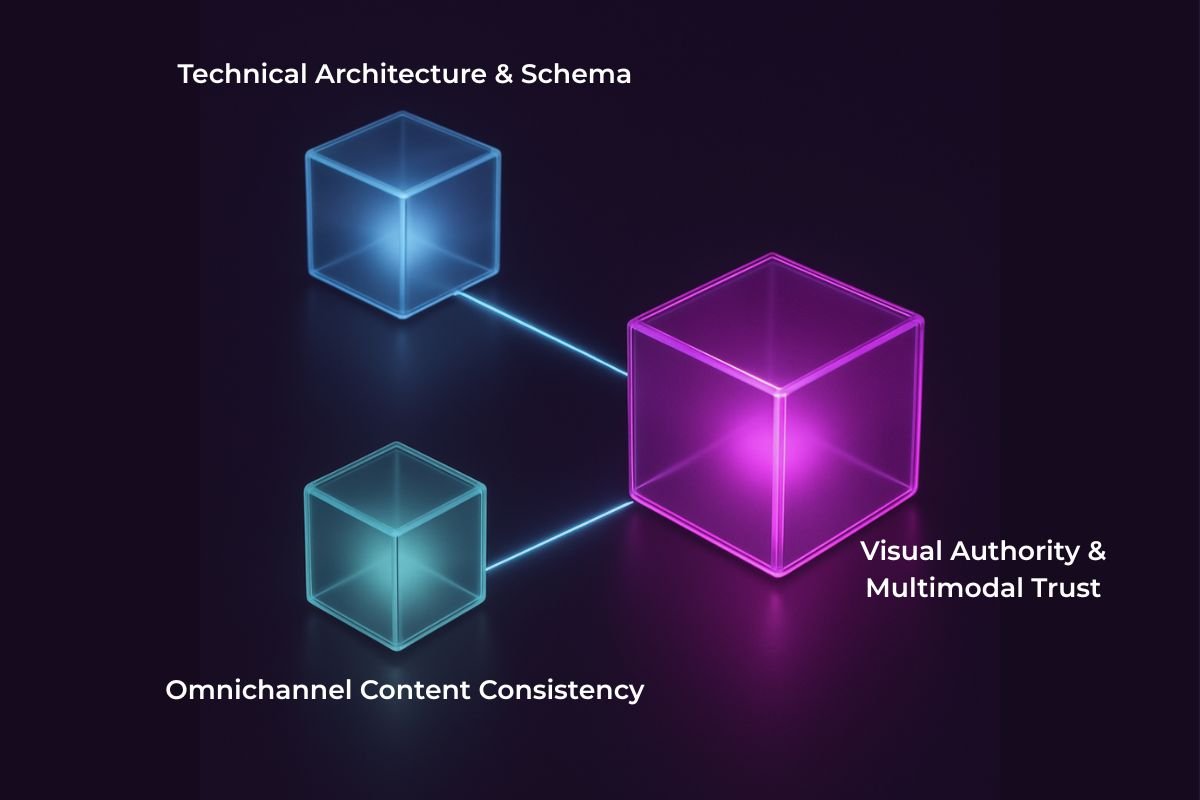
Technical SEO & Schema: Are you using JSON-LD schema to explicitly tell search engines who you are?
Omnichannel Content Consistency: Does your LinkedIn persona contradict your blog? Is your "About Us" page consistent with your press releases?
Visual Authority: Your imagery is data in a multimodal world. We audit your digital footprint to ensure your visual assets act as trust signals for AI models.
Why Traditional SEO Agencies Are Falling Behind
You can take this "AI Roadmap" to a traditional SEO agency. However, traditional SEO is, by nature, archaeology. It relies on lagging indicators, historical data, and keyword volumes to predict what worked six months ago.
AI search renders the "historical data" model obsolete for three reasons:
Hyper-Personalization: There is no longer a single "Page 1." The answer generated for a CEO in New York differs from that generated for a Founder in London.
Infinite Query Variation: Users don't type keywords; they have conversations. You cannot optimize for a keyword string when the question changes every time.
Predictive Generation: AI anticipates the user’s next need. It doesn't just retrieve; it synthesizes.
To secure your place, you cannot drive looking in the rearview mirror. You need a cohesive signal that spans technical architecture, content, and visual authority.
The Two Pillars of Modern Entity Recognition
1. Closing the Omnichannel Gap
Standard agencies operate in silos. They handle your technical SEO but ignore your social video strategy.
However, your entity is defined by its relationships across the entire web. If your technical schema says one thing but your YouTube channel says another, the entity is fractured.
Penpixel Creative ensures your "machine-readable" data (Schema) aligns perfectly with your "human-readable" content.
2. Solving the Visual Authority Deficit
This is the piece most people miss: AI models are multimodal. They process images and video as data, not just decoration.
Traditional SEO treats logos and imagery as placeholders. But in the AI era, high rankings are merely the prerequisite. AI tools use traditional algorithms to "fetch" content (Retrieval), but they use their own reasoning models to decide what to do with it (Generation).
If your technical SEO is perfect, the AI will "see" your content. But if your visual identity looks amateurish, generic, or inconsistent, the AI (which recognizes quality patterns) will deem your entity "low authority" and exclude you from the final recommendation.
The Penpixel Mantra: > Traditional SEO gets you into the room.
Entity Optimization gets you mentioned in the speech.
The Blueprint to Becoming Unavoidable
Your brand’s reputation is no longer determined solely by human perception. It is now in the hands of machines that associate concepts at a scale humans cannot fathom. If you ignore the Entity Layer, you are leaving your brand narrative to a predictive algorithm that is just as likely to hallucinate as tell the truth.
Stop fighting for keywords. Start defining your identity.
Ready to take control of your brand's AI narrative?
Is AI describing your business correctly? Request an AI Visibility Audit today to reclaim your identity.
Want to offer Entity Optimization to your clients? Partner with Penpixel for white-label AI solutions and technical auditing.